
Mukherjee said uncertainty was still there on oil prices front due to unrest in West Asia and North Africa.

The muted CPI inflation print at 5% earlier this week, followed by a similar WPI number released Wednesday, seems to have spurred India's central bank into action, is how the economists are reading into Reserve Bank of India governor Raghuram Rajan's 25 basis point cut in repo rate.

With the 115 bps reduction in repo rate beginning February, banks have already transmitted 72 bps to the customers on fresh loans and some large banks have transmitted as much as 85 basis points.

The Reserve Bank has kept the key policy rates unchanged, while the Cash reserve Ratio (CRR) has been cut by 25 bps to 4.25%.

The consumer price index (CPI)-based inflation hitting an all-time low in October would encourage the six-member monetary policy committee (MPC) of the Reserve Bank of India (RBI) to cut the policy repo rate in its upcoming December 3-5 meeting. However, the July-September GDP growth, expected to be above 7 per cent, may act as a deterrent.

The Reserve Bank of India (RBI) on Wednesday kept its policy interest rate unchanged at 5.5 per cent for the second consecutive time, citing concerns over tariff uncertainties.

CRR remains unchanged at 4%; first repo rate cut since May 2013.

After raising interest rate by a cumulative 250 basis points in 11 months, the Reserve Bank of India (RBI) on Thursday unexpectedly kept benchmark rate unchanged as global banking woes added uncertainty to the economic outlook. Five out of six members of MPC voted to remain focused on the withdrawal of accommodation to ensure inflation aligns with target while focusing on growth, RBI Governor Shaktikanta Das said on Thursday. The Monetary Policy Committee of the central bank decided to take a pause after a rate hike seen in previous six consecutive policies.

Today, the economy requires a certain amount of push not just from the monetary policy but also from its transmission: Das.

Despite the Reserve Bank of India's (RBI) and the government's recent initiatives to attract foreign capital, which are expected to alleviate pressure on long-duration bonds, most debt fund managers are maintaining a cautious stance, favouring shorter-duration papers due to global uncertainties and potential future rate hikes.
The Reserve Bank of India has no plans to cut the short-term repo rate for some time, a senior central bank official said on Thursday.
The primary focus of monetary policy remains the containment of inflation and anchoring of inflation expectations.

The economic growth is likely to moderate to 6.1 per cent, slowest in over seven quarters, from 6.6 per cent last year same period.
Majority of the experts expect a 25 basis point reduction.

High frequency indicators suggest that a growth recovery is underway, but very tentatively and with weak legs, says Saugata Bhattacharya.

The repo rate, at which RBI lends to the banking system, will be at 7.5%

The repo rate, at which the central bank lends to the system, will come down to 5.75 per cent after the cut.
Uncertainties stemming from the West Asia crisis and its potential impact on inflation and economic growth were key factors in the Reserve Bank of India's Monetary Policy Committee (MPC) decision to maintain the status quo on interest rates, according to the recently released MPC meeting minutes.

Shrugging off concerns over the depreciation of rupee, the RBI has cut interest rate by 25 basis points to 5.25 per cent in a bid to further bolster economic growth, which rose to a six-quarter high of 8.2 per cent in the second quarter of the current financial year.

Indian carmakers experienced a robust start to the new fiscal year, with an estimated 4.5 lakh passenger vehicles sold in April, marking a 27 per cent increase year-on-year, attributed to factors like GST 2.0, repo rate cuts, and income tax benefits.
Beyond the fourth quarter of 2019, the report does not see space for further cuts primarily as headline inflation is likely to pick up and cross the 4 per cent target by the end of the year, and output gaps are also estimated to close.
The new rate will be effective from December 8. The primary liquidity made available to the system through these measures is worth over Rs 3,00,000 crore (Rs 3,000 billion), RBI Governor D Subbarao said in Mumbai.

Titan surged 2.98 per cent, followed by IndusInd Bank, ITC, JSW Steel, Infosys, Tech Mahindra, Tata Consultancy Services and Maruti. Hindustan Unilever, Asian Paints, Bharti Airtel and HDFC Bank were among the laggards.
The Reserve Bank of India (RBI) on Wednesday announced to increase the policy repo rate by 50 basis points to 4.9 per cent, the second hike in five weeks aimed at quelling the inflation. The MPC vote was unanimous and has decided to keep stance withdrawal from accommodative, RBI Governor Shaktikanta Das said in a press conference on Wednesday. The decision was taken during a three-day meeting of the RBI's Monetary Policy Committee (MPC) to review the interest rates in the country. The MPC voted unanimously to increase the policy repo rate by 50 bps to 4.90 per cent," Das said.

Shrugging off concerns over the depreciation of rupee, the RBI has cut interest rate by 25 basis points to 5.25 per cent in a bid to further bolster economic growth, which rose to a six-quarter high of 8.2 per cent in the second quarter of the current financial year.
This is the fifth straight cut in rates by the Reserve Bank of India in as much policy reviews in 2019, and takes the total quantum of reductions to 1.35 per cent.

'Banking is the only sector that can see double-digit growth in FY27.'

The global brokerage firm believes that CRR cut is likely to help cut lending rates and revive growth sentiments.

State-owned Bank of Baroda (BoB) on Sunday said it has cut its benchmark lending rate linked to repo rate by 50 basis points in line with the RBI's rate reduction. Meanwhile, private sector HDFC Bank reduced its Marginal Cost of Funds-based Lending Rates (MCLR) by 10 basis points across tenure, which will benefit borrowers whose loans are linked to this benchmark.

The report, however, said it remains watchful of the upside risks to inflation emanating from pass-through of minimum support prices (MSPs), adverse movement in crude oil prices, volatility in global financial markets, lagged impact of the rupee weakness on input prices, adverse implications from fiscal slippage and staggered impact of HRA increases by states and its second-round impact.

Activity in the corporate bond market is set to gain momentum following a 25-bp policy repo rate cut by the rate-setting panel of the Reserve Bank of India (RBI). State-owned public cebPower Finance Corporation (PFC) and Small Industries Development Bank of India (Sidbi) are planning to raise up to Rs 11,500 crore through bonds on Tuesday as issuers expect borrowing costs to ease.
CLSA says government actions to facilitate investment more important for revival than a token monetary easing.

The Reserve Bank is likely to cut the repo rate by 25 basis points (bps) after the Budget.

The Reserve Bank of India (RBI) Governor Sanjay Malhotra is now confronting the classic growth-inflation tradeoff, a situation exacerbated by the West Asia war, which threatens to end the 'goldilocks period' of low inflation and robust growth.
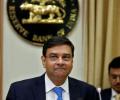
Governor Urjit Patel and his deputies spoke to the media about the central bank's decision to raise the repo rate.

Reserve Bank of India Governor Shaktikanta Das on Friday said the central bank will ensure adequate liquidity in the system to ease the financial stress caused by the Covid-19 pandemic. The central bank reduced the reverse repo rate -- the rate at which banks park their fund with the central bank -- by 25 basis points to 3.75 per cent.

Private sector lender IDFC First Bank has lowered its savings account rates and introduced new slabs for small and medium balance categories, effective January 9, 2025, as per its website. The interest slabs and rates for higher balance accounts remain unchanged. Despite the revision, the bank continues to offer one of the highest savings account interest rates in the industry among mid-sized banks.

Home purchase affordability has improved in the first half of calendar year (CY) 2025, after the RBI reduced the repo rate by 100 basis points (bps), according to real estate consultancy Knight Frank India.

Fuel prices have risen by about Rs 7.5 per litre since May 15, as global crude oil prices surged due to the ongoing conflict in West Asia and supply concerns around the Strait of Hormuz.

India's total automobile retail sales recorded a significant 9.55 per cent year-on-year growth in May, reaching an all-time high of 25,31,067 units, driven by strong performances in three-wheelers, passenger vehicles, and tractors, despite prevailing heatwave conditions and fuel price pressures.
